
Use Moving Averages for Sell Signals
Moving averages can be very helpful for providing sell signals in an uptrend. To sell with a moving average, the stock should have a profit cushion. The idea is to let your profits run until the time that the stock becomes weak and falls below moving average support.
The first bar that closes below the moving average (Bar 1) is called the violation bar, and it is a warning that the stock is acting weak, especially if the volume is above average. If the next bar (Bar 2) trades below the low of Bar 1, it becomes a Continuation Bar, and the stock is generally sold. In the Pro trend system, this is called the 2-bar Exit Rule.
For an early exit, the 10 moving average can be used for the sell signal. For a more conservative exit, the 50 moving average can be used. Much depends on the amount of the profit cushion and the condition of the general market.
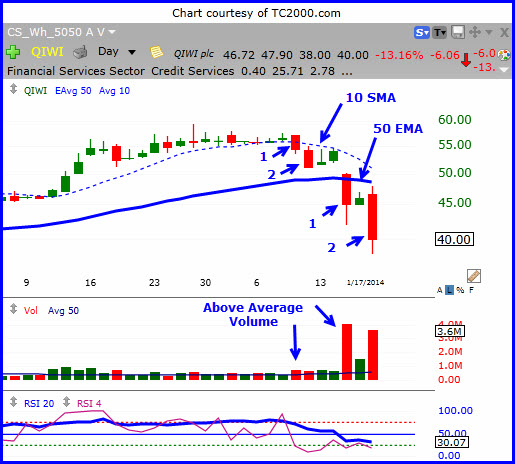
The daily chart of QIWI is a good example of selling below a moving average. On 9 January, the stock closed below the 10 moving average for the first time (Bar 1). Bar 2 traded below the low Bar 1, and this was a good signal to sell.
On 15 January, QIWI violated the 50 moving average, and two days later it traded lower. This was a second opportunity to sell the stock. In conclusion, moving averages are areas of support in a uptrend. When the moving average fails to provide support, it may be time to take profits (full or partial) and exit the position safely before things potentially get worse.