
Two Secrets for Trading REITs
Real Estate Investment Trusts (REITs) are dividend-paying securities which trade like stocks. REITs invest in income-producing real estate (residential, commercial) and pass on the rental earnings to investors in the form of dividends. Using REITs, investors are able to gain investment exposure to real estate without having to buy property.
The main secret to trading REITs is to approach them like a stock, not simply a dividend investment. REITs are considered defensive, and they can give the investor a false sense of safety. Altisource Residential Corporation (RESI) provides a great example of how a REIT can leave the investor with a losing trade (see below)
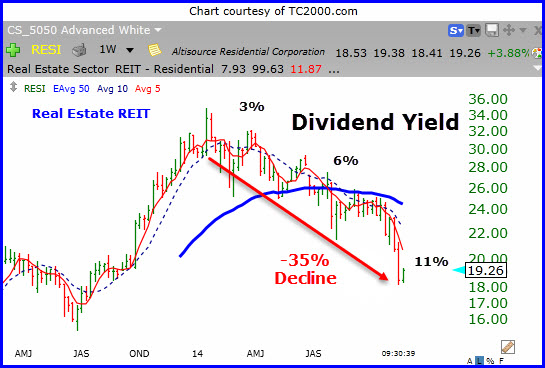
REITs have downside risk, just like stocks. Above is a weekly chart of RESI. In early 2014, the REIT began a -35% decline in 10 months. Before the decline, RESI was paying a +3% yield. Had an investor bought RESI for the 3% dividend, the net loss would be -32% (-35% capital loss +3% dividend = -32% net loss).
To protect against big losses, trade REITs like a stock, using the 50/50 Strategy or some other trend trading approach which gives timely entry and exit signals. The downside risk must be managed. Look for REITs that are breaking out of consolidation patterns and making new highs or those that have retraced to the 50 EMA and found support (50/50 "long" signal).
Another secret when trading REITs is to never buy a REIT simply for its high yield. The dividend yield rises as the price falls. Assuming a REIT's dividend "amount" remains constant, it will become a larger percentage of the REIT's price as the price falls. So make sure you look at the chart pattern before buyinga high-dividend REIT, and avoid those REITs with bearish price patterns.