
The 1% Risk Rule
Preserving capital is a major concern for traders. To do this, many successful traders recommend keeping your maximum trade risk to 1% of trading capital (or less if possible) per trade. The 1% rule is protective for your portfolio, and it is a good practice to avoid blowing out your account. Using a 1% risk means that you would have to lose on ten trades in a row in order for you have a 10% draw down in your account.
For example, if your trading capital is $50,000, then 1% would equal $500 (.01 x $50,000 = $500). This means that the maximum loss you should take on any "one" trade is $500. But just because you can afford to lose $500 does not mean you should accept this amount of loss if the price/volume signals tell you to exit a trade earlier.
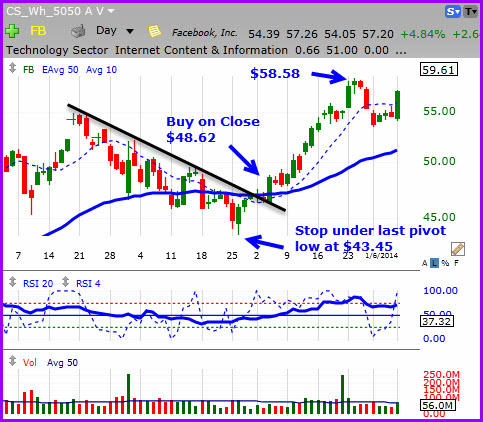
The 1% rule should be used as a double check of risk trade setups. Suppose you want to allot $5,000 to buy Facebook (FB) on the close at $48.62 (see arrow). With $5,000, you can afford to buy 100 shares. The last pivot low was at $43.55 (see arrow), so you decide a good stop loss would be at $43.45 ($0.10 cents under the pivot low).
This gives a risk (if stopped out) of $5.07 per share ($48.62 entry - $43.45 = $5.07). If stopped out, the loss would be $507 ($5.07 risk x 100 shares = $507). Is this within the allowable 1% limit? As a double check, we already know (discussed in 2nd paragraph, above) that 1% of trading capital would be $500, so the 1% risk is within $0.07cents. That's close enough.
Remember, the 1% rule is just a ballpark figure, and a more detailed analysis may allow a tighter risk point.
Important Disclaimer:
The information presented in the Stock Pick of the Week is for informational purposes. The information was based on data and charting programs from independent services and CC Trader LLC d/b/a TradeLikeaPro does not guarantee the accuracy of the information used in the analysis of securities presented. The information is not offered as a basis for making trading decisions based on securities presented. Investors and traders should conduct their own independent research before making any investment. Nothing contained herein should be construed as a recommendation to buy or sell any securities. Investing and trading involves risk. Before deciding on any investment, you should consider your investment objectives, level of experience, and risk tolerance. Do not trade with money you cannot afford to lose. You should seek investment advice from a professional investment advisor before engaging in investment activities.
Traders should check numbers for accuracy before relying on them for trading decisions because typographical errors will sometimes occur.