
Market Breadth--Don't Trade Without It
Market breadth is the number of NYSE stocks that are advancing minus the number of stocks that are declining. Market breadth is positive when more stocks are advancing and negative when more stocks are declining. The market breadth number is important, and numbers greater than +1,000 are very bullish while numbers less than -1,000 are very bearish.
Market breadth is an important key to supporting stock purchases "intraday." The trader can compare the price action of a stock being purchased to the market breadth. The two should be in sync.
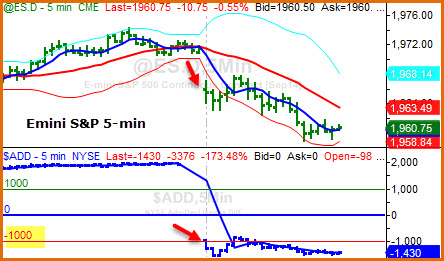
For example, the chart above shows the Emini S&P continuous contract (proxy for the market) on 21 July 2014. The Emini opened lower, and the market breadth opened near -1,000 (bearish). This means that the "opening" tone of the market was very bearish.
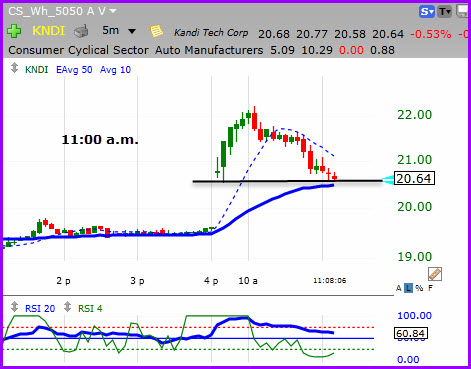
At the same time, Kandi Tech (KNDI) gapped up nearly +6% and rose to an intraday high of +13% in the first 30 minutes of the day. In such instances, a trader is best advised to wait on buying the stock at the open because strong negative breadth usually drags down the majority of stocks. That is what happened with KNDI.
By 11:00 a.m., KNDI had fallen back to the 5-min 50 EMA (solid blue line), erasing all of the gains following the gap up open. A trader would likely have a losing trade if KNDI had been bought as it rose off the open.
Market breadth changes throughout the day, so monitoring is important. If market breadth remains bearish, the trader should exercise caution in buying stocks. If buying is considered, it's usually best to wait for the market to find support and the market breadth to begin trending up.
Important Disclaimer:
The information presented in the ProSelect Stock Report is for informational purposes. The information was based on data and charting programs from independent services and CC Trader LLC d/b/a TradeLikeaPro does not guarantee the accuracy of the information used in the analysis of securities presented. The information is not offered as a guide for trading ideas and setups. Investors and traders should conduct their own independent research before making any investment. Nothing contained herein should be construed as an automatic recommendation to buy or sell any listed security. Investing and trading involves risk. Before deciding on any investment, you should consider your investment objectives, level of experience, and risk tolerance. Do not trade with money you cannot afford to lose. You should seek investment advice from a professional investment adviser before engaging in investment activities.
Traders should check numbers for accuracy before relying on them for trading decisions because typographical errors will sometimes occur.
(c) CC Trader LLC d/b/a TradeLikeAPro 2014. All Rights Reserved.