
Buy Gaps with Huge Volume
Buying gaps can be an easy way to enter stocks in high demand, but discerning between common gaps and breakaway gaps is essential for success.Traders may shy away from buying gaps because they might see the stock as too "extended," and they may figure they "missed it." Using a few rules can help increase confidence in buying gaps.
First, it's best if you are familiar with the stock, so you can buy it on the open without hesitation. Make sure the stock is fundamentally strong, so there is a reason it might be in high demand.
Second, the stock should be emerging "out of" a consolidation pattern. If the stock gaps up "within" a pattern, it is not a buy because it is more likely to be a common gap.
Third, there should be high volume, and the higher the better. Generally, the volume on the gap up day will depend on how high it gaps up, but a good rule is to expect a doubling of the 50-day average volume.
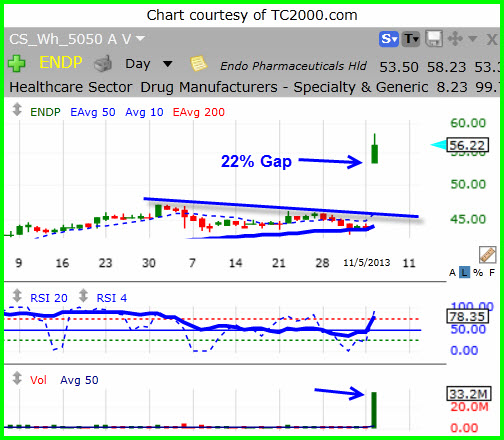
In the example of ENDP above, the stock gapped up with volume that was 9 times normal; this huge volume only occurs with large institutional buying. ENDP gapped up 22% and closed the day up 28%. Note how the stock broke out above a well-defined, descending resistance line.
For a stop loss, a good rule is to sell if the price violates the low of the gap up day bar by 1-2%. Don't wait to see if the gap fills. If price moves sideways, that is generally a okay sign, because the market has to digest the big jump in price. The best scenario is when the stock rises for a few days after the gap up, and then retraces to support at a level higher than the gap up day's low.