
Buy ETFs to Short the Market
Shorting stocks involves a higher skill level than buying stocks, so shorting ETFs can be a safer way to take advantage of market downtrends. ETFs are diversified, so they are less volatile than stocks, and there is less chance of being stopped out. During a market downtrend, traders new to shorting might want to consider trading ETFs before looking to short individual stocks.
Downtrends tend to drop faster than uptrends rise, so timing shorts with stocks is much harder, and shorting too late makes the trader vulnerable to short-covering rallies. When a stock drops to a certain level, shorts begin to cover their position buy "buying" back stock shares. In addition, there are bulls that see the beaten down stock as an opportunity to "buy" a stock on the dip. This double-buying effect leaves few sellers to hold the stock down, and it rises sharply, stopping out shorts that entered too late. This is called a "short squeeze."
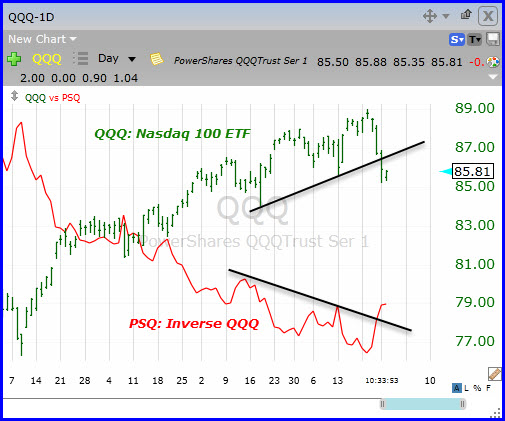
The chart above shows the QQQ (Nasdaq 100 ETF) compared to the PSQ (Inverse QQQ ETF). Note how they move in opposite directions. As the QQQ broke below its uptrend line in late January, the PSQ broke above its downtrend line.
As an alternative to shorting stocks, traders can short the entire market by using ETFs of market indices. For instance, a trader can short the S&P 500 by trading the SPY, the Nasdaq 100 by trading the QQQ, and the Dow Industrials by using the DIA. To short, the brokerage account must be set up with margin privileges.
If a trader wants to short without using margin, or in a retirement plan, they can "buy" inverse ETFs (SH, PSQ, DOG, respectively) instead. Invesrse index ETFs move opposite to movement of the index (see chart above). There are also leveraged ETFs (both long and short) which will amplify both gains and losses, but these should be traded by experienced traders.